Energy Security / C-UAS Forum

Co-located With the Energy Drone & Robotics SummiT

June 24, 2026 | 9:00 AM – 1:00 PM | Woodlands Waterway Marriott

Limited Seating

The sky above your facility is now part of your critical infrastructure security perimeter. 

State-sponsored actors, extremist groups, and opportunistic adversaries have identified energy infrastructure as a high-value, under-defended target. 

This timely half-day forum convenes the security leaders, owner-operators, regulators, service solution providers, public safety agencies and technology innovators who are writing the new playbook, before the next incident forces your hand.

** The Energy Security / C-UAS Forum registration is included with an EDR Summit All-Access Conference Pass


Why This Conversation Can’t Wait

The energy facilities and electric grid was never designed with aerial threats in mind. Drones are inexpensive, widely available, and increasingly capable — which means your security perimeter no longer ends at the fence line. 

Modern UAS threats are analogous to cyber threats: low-cost, scalable, and capable of creating disproportionate damage far beyond the point of attack. The time to act is before the breach, not after.

Reconnaissance & Site Mapping

Most drone incidents near critical infrastructure currently involve surveillance like mapping facility layouts, identifying weak points in physical security, and testing response times. 

This intelligence feeds far more coordinated follow-on attacks, both physical and cyber.

State-Sponsored Targeting

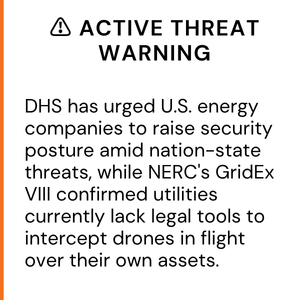
DHS has explicitly warned U.S. energy companies about nation-state threats. Global conflicts have demonstrated that refineries and generating stations are valid military targets, a strategic calculus now being applied to the U.S. homeland by adversaries including Iran.

The Regulatory & Legal Gap

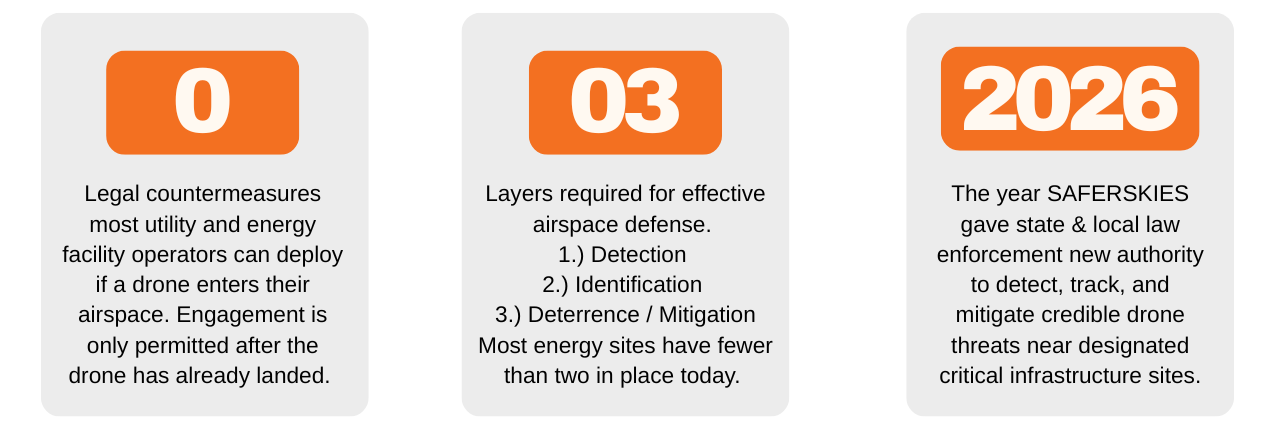
FAA airspace rules leave utilities able to observe threatening drones but unable to legally interdict them in flight. 

Operators are stuck watching a potential attack unfold and can only respond after the drone lands, often too late to prevent harm to personnel or critical equipment.


Who Should Attend?

This forum is purpose-built for the security decision-makers, operations leaders, and technology evaluators responsible for protecting energy infrastructure — and who need actionable intelligence, peer experience, and regulatory clarity, not theory.
  • Physical Security Director or Manager at a utility, pipeline, or O&G company

  • Chief Security Officer or VP of Security for an energy asset owner/operator

  • Operations or Facility Manager responsible for site safety and access control

  • UAV/Aviation Program Lead or Robotics/Technology implementation team

  • Compliance Officer managing NERC CIP or physical security standards

  • Emergency Response or Crisis Management Leader

  • Government Relations professional tracking C-UAS and infrastructure policy

  • Technology Evaluator or Procurement Lead for physical security systems

  • Law Enforcement or Homeland Security official with energy sector responsibilities


Core Topics

01 — Airspace Threat Intelligence

Understanding who is operating near your assets, why, and what NERC GridEx data and DHS warnings reveal about the rising threat of state-sponsored targeting of U.S. energy infrastructure.

02 — Counter-UAS Technology 

From radar and RF detection to AI-powered identification and RF Cyber takeover mitigation — the full technology stack assessed for industrial environments where jamming is simply not an option.  Ground based robotics and fixed systems for security. What are the new and emerging technologies available for Deterrence and Mitigation?

03 — Regulatory Compliance

NERC CIP-014, the SAFERSKIES Act, and the FY2026 NDAA framework — what the evolving regulatory landscape means for asset owners and how to get ahead of mandatory compliance requirements.

04 — Public-Private Partnerships

How energy operators are building coordination frameworks with SLTT law enforcement agencies under new federal authority to create legally defensible, rapid-response airspace protection programs.

05 — Physical Security Integration

Integrating airspace monitoring with existing ground based perimeter security, surveillance systems, and emergency response protocols to create a unified, defense-in-depth security posture across the full facility footprint.

06 — Upstream & Downstream O&G

Specific considerations for refineries, petrochemical complexes, and upstream production sites where explosive atmospheres and process sensitivity demand strictly non-disruptive, non-kinetic mitigation approaches.

07 — Utility & Grid Security

Protecting substations, transmission infrastructure, and generating stations — assets that are geographically dispersed, irreplaceable, and historically designed with zero consideration of aerial threats.

08 — Procurement & Deployment

How to evaluate C-UAS vendors, structure public-private agreements, and deploy layered detection and mitigation systems within the budget and operational realities of energy facility security teams.


C-UAS Is Becoming Mandatory. Don't Wait for the Breach.

Asset owners who wait for regulations to arrive before building airspace security capability will be left scrambling. The FY2026 NDAA has already created new frameworks. NERC CIP-014 updates are accelerating. DHS is actively warning operators. The question is no longer whether to act — it's whether you act on your terms, or the regulator's.

SAFERSKIES Act (FY2026 NDAA) — New authority for state and local law enforcement to detect, track, and mitigate credible drone threats near designated critical infrastructure sites.

NERC CIP-014 Evolution — Growing industry push to update physical security standards to explicitly include airspace defense as a required protective measure for high-impact facilities.

Active DHS Warnings — The Department of Homeland Security has directly urged U.S. energy companies to increase security in response to confirmed threats from nation-state actors.

NERC GridEx VIII Findings — Industry stress-test participants called for consolidated federal guidance and new government support, confirming the current regulatory framework is insufficient.


Why Attend?

Peer Intelligence — Hear directly from asset owners and operators who are actively deploying — or evaluating — C-UAS systems at real facilities, not consultants theorizing from the sidelines.

Regulatory Clarity — Leave with a clear-eyed picture of the NERC CIP, SAFERSKIES, and FY2026 NDAA landscape — and a concrete sense of what compliance will require before the mandates arrive.

Technology Evaluation — Cut through vendor noise with expert-led sessions on what detection and mitigation technologies actually work in industrial environments — and which approaches create new risks.

Actionable Frameworks — Walk away with a layered-defense framework and a clear roadmap for building public-private coordination agreements with law enforcement under the new federal authorities.

Full EDR Summit Access — Forum registration includes full access to the Energy Drone & Robotics Summit — the industry's premier event for drone and robotics technology across the energy sector.

Senior-Level Networking — Connect with the security leaders, technology providers, regulators, and law enforcement officials who are collectively shaping the future of energy infrastructure protection.

What’s Being Discussed

Agenda – June 24, 2026

9:00 AM KEYNOTE The Sky Is the New Front Line: Setting the Stage for Energy Security in 2026

A hard-hitting scene-setter drawing on NERC's GridEx VIII findings, the DHS warning to U.S. energy operators, and the geopolitical realities reshaping physical and airspace security strategy for substations, refineries, pipelines, and critical generation assets.

9:25 AM PANEL From Fence Line to Skyline: What Utilities and Operators Are Actually Doing Right Now

Asset owners from electric utilities, pipelines, and oil & gas share candid accounts of their current airspace security posture — detection capabilities deployed, gaps identified, incidents experienced, and how they are coordinating with local law enforcement under the new SAFERSKIES Act framework.

10:15 AM Why Jamming Fails and What Actually Works: The RF Cyber Mitigation Playbook

In a refinery or chemical plant, jamming creates RF noise that can disrupt industrial sensors, internal communications, and safety systems — and a drone crashing near pressurized lines is not a solution. This session examines the move toward RF Cyber "takeover" technology that surgically seizes control of a rogue UAS and guides it to a pre-designated safe landing zone without disrupting facility operations.

10:30 AM Robots on the Ground: How Autonomous Security Platforms Are Patrolling the Perimeter

As aerial threats multiply, the perimeter itself is being rethought. This session examines the emerging role of ground-based autonomous robots in energy facility security — from continuous perimeter patrol and anomaly detection to real-time situational awareness and coordinated response. Hear how operators are deploying wheeled and tracked UGVs to cover large, complex facility footprints that traditional guard forces and fixed cameras cannot adequately monitor, and how ground robots are being integrated with airspace surveillance systems to create a unified threat picture.

10:45 AM Upgrade, Don't Replace: Maximizing Your Existing Security Infrastructure

Most energy facilities already have cameras, acoustic sensors, radar, and perimeter detection systems in place — but these legacy assets were never designed to handle the drone threat or communicate with one another. This session focuses on how operators are extending the useful life of existing security technology through software upgrades, AI-powered analytics layers, sensor fusion platforms, and cloud-based command-and-control integration. Learn how to retrofit existing camera arrays for drone tracking, add acoustic detection overlays, integrate RF sensors alongside legacy radar, and build a unified operating picture without ripping out and replacing capital infrastructure.

11:00 AM Refreshment Break & Technology Exhibition Access

Connect with C-UAS solution providers, ground robotics vendors, security technology integrators, and fellow operators from across the energy sector on the EDRS exhibition floor.

12:00 PM NERC CIP-014, SAFERSKIES, and What's Coming: The Compliance Landscape for Airspace Security

C-UAS is moving rapidly from an optional investment to a mandatory compliance requirement. This session breaks down the current regulatory framework — including the FY2026 NDAA's expanded C-UAS authorities for state and local agencies under SAFERSKIES — and what asset owners need to put in place before formal mandates arrive. Don't wait for the regulations to tell you what to do.

12:30 PM Building Layered Airspace Defense: Detection, Identification, and Mitigation in Practice

A practitioner-led panel on deploying the full three-layer C-UAS stack — RF sensor and AI-camera detection, friend-or-foe identification, and non-disruptive cyber-based mitigation — within real-world operational constraints at energy facilities. Open audience Q&A closes the session.

1:00 PM Forum Concludes


Get Involved With This Timely Forum Today

Join security leaders, operators, regulators, and technology innovators for the energy sector's first dedicated forum on physical and airspace security. Seating is limited — reserve your place today.

Date: Tuesday, June 24, 2026

Time: 9:00 AM – 1:00 PM  ·  Half-Day Forum

Co-located with: The Energy Drone & Robotics Summit

Included: Forum registration includes full EDR Summit 2026 Sessions and Expo access